MaskROM compute-in-memory · hardwired LLM · model in silicon · ROM-based CIM · weights in silicon
MaskROM Compute-in-Memory: What Casting Weights in Silicon Means
Fanshi Semiconductor engineering team · Published
MaskROM compute-in-memory casts model weights into a via array in the silicon through the mask patterns used at tape-out, so the weights become part of the chip's structure. At runtime nothing has to be read out or moved: multiply-accumulate happens in place in the array, which gives the lowest power and marginal cost per inference of any route. The trade-off is a fixed model; changing it requires new masks.
The weights become part of the silicon
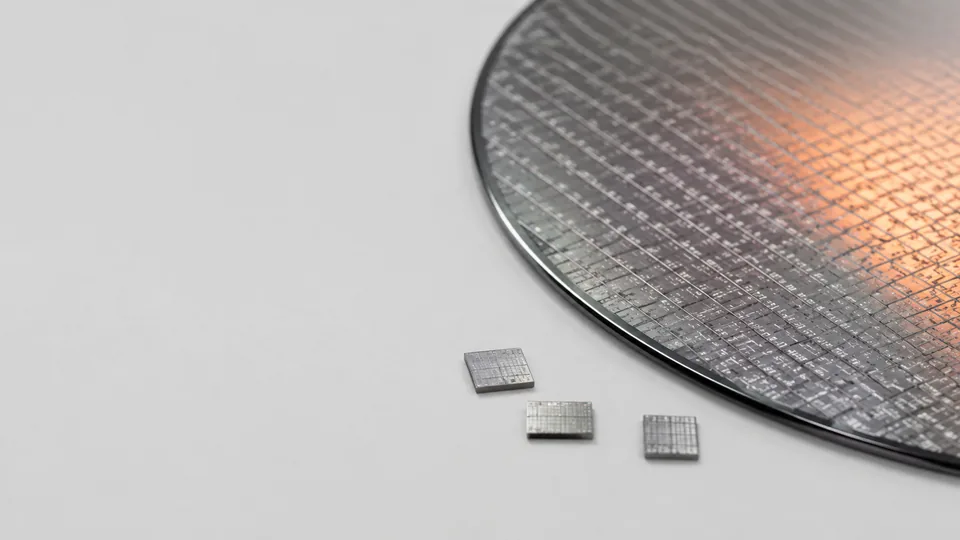
In an ordinary chip, the memory cells ship empty and the weights are loaded from outside at power-up. MaskROM is different. At design time, the value of every weight is translated into the presence or absence of vias and connections, drawn into the photomask and manufactured into the silicon along with everything else. When the chip leaves the fab, the model is already inside.
Because the weights are circuit structure, there is no read-out step. As activations flow through the array, multiply-accumulate completes in place in the circuitry beside the via array, and what comes out is results, not weights. That is what casting a model into a chip literally means.
Why it has the lowest power and cost
During LLM decoding, the largest energy cost is moving weights, and MaskROM removes it entirely. It also needs no DRAM or HBM, which takes an expensive memory chip off the BOM along with its power and board area.
A MaskROM cell is tiny: it does not need six transistors per bit as SRAM does. The same silicon area holds far more weights, which is why it can carry a complete language model on a mature process node.
The masks are a one-time cost. After that, each chip costs only its die area and packaging, so the higher the volume, the smaller the mask cost per unit.
The limit: a fixed model
Once the weights are cast into silicon they cannot change. A different model means new masks and a new tape-out, so the MaskROM route assumes the model is frozen and thoroughly validated in the field.
A common engineering approach is to put the stable bulk of the model, such as the language-model backbone, in MaskROM and keep the parts that need tuning, such as a small set of adapter layers or prompts, in writable memory. The exact split is assessed per project against the model's structure.
Products it suits
Handheld translators, voice memo hardware and offline in-car voice assistants share a profile: a clear model task, high volume, extreme power sensitivity and no need for a network connection. Fanshi's Forge is defined for exactly these devices: the MaskROM route with Qwen 3.5 0.8B as its core model, and design targets of sub-watt-class system power and 17,000 token/s decode speed.
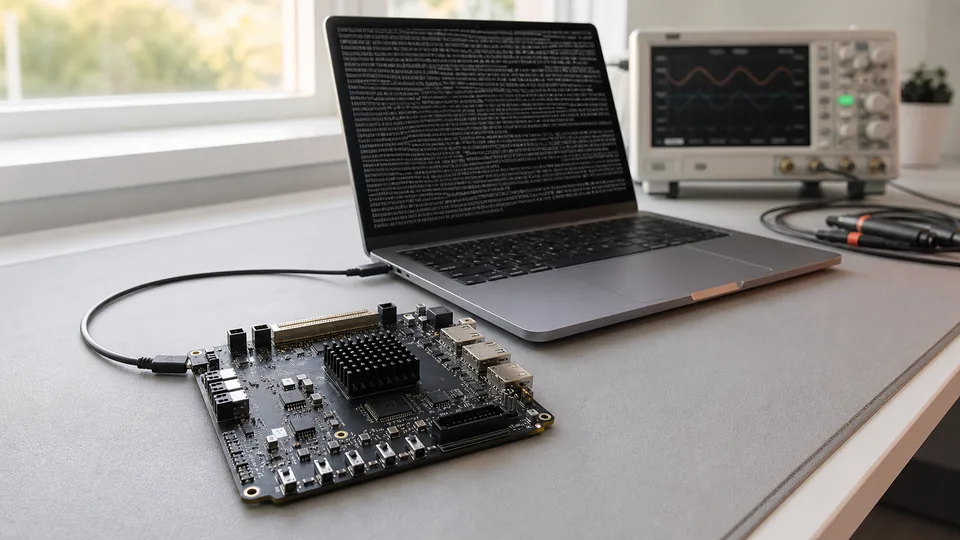
If your model is not frozen yet, bring it up on an FPGA evaluation board with inference IP first, and move to a MaskROM tape-out once the model is locked.